If you’re a musician on the go, finding a bus-powered audio interface that meets your needs can be a challenge. You want something reliable, portable, and capable of delivering high-quality sound. From the Focusrite Scarlett Solo to the versatile Zoom AMS-44, there are solid options available. But how do you decide which one fits your style best? Let’s explore the top contenders to help you make an informed choice.
Focusrite Scarlett Solo 3rd Gen USB Audio Interface

The Focusrite Scarlett Solo 3rd Gen USB Audio Interface is perfect for solo musicians, podcasters, and content creators who need a reliable, high-quality recording solution. With high-performing mic pre-amps and switchable Air mode, you’ll capture bright, clear sounds for your vocals and acoustic instruments. Two high-headroom instrument inputs let you plug in guitars and bass without worrying about clipping or distortion. You’ll achieve professional recordings with 24-bit/192kHz converters, ensuring low noise for pristine audio playback. Plus, the included software—like Pro Tools Intro+ and Ableton Live Lite—gives you essential tools for immediate music creation, making it an invaluable addition to your setup.
Best For: Solo musicians, podcasters, and content creators seeking a reliable and high-quality recording solution.
Pros:
- High-performing mic pre-amps enhance clarity and brightness of recordings.
- Supports professional 24-bit/192kHz recording quality with low noise for clear audio playback.
- Includes essential software tools like Pro Tools Intro+ and Ableton Live Lite for immediate music creation.
Cons:
- Limited to one microphone input, which may not suit larger recording setups.
- Lacks advanced features found in more expensive audio interfaces.
- No MIDI input/output, limiting connectivity for certain instruments and devices.
Focusrite Scarlett Solo 4th Gen USB Audio Interface

Designed specifically for guitarists, vocalists, and producers, the Focusrite Scarlett Solo 4th Gen USB Audio Interface stands out with its exceptional sound quality and user-friendly features. With a 120dB dynamic range, it guarantees studio-quality recordings using the same converters as Focusrite’s flagship models. You’ll love the improved Air mode, which enhances vocals and guitars, delivering rich harmonic drive for impactful recordings. Plus, it comes bundled with top-tier software like Pro Tools Intro+, Ableton Live Lite, and Cubase LE, along with the Hitmaker Expansion, giving you everything you need for recording, mixing, and mastering your music effortlessly.
Best For: The Focusrite Scarlett Solo 4th Gen USB Audio Interface is best for guitarists, vocalists, and producers seeking high-quality, studio-grade recordings.
Pros:
- Studio-quality sound with a 120dB dynamic range, comparable to professional setups.
- Enhanced Air mode improves the clarity and presence of vocals and guitars.
- Comprehensive software bundle includes Pro Tools Intro+, Ableton Live Lite, and Cubase LE for all recording needs.
Cons:
- Limited inputs may not suit those needing to record multiple instruments or vocalists simultaneously.
- Some users might find the software setup process a bit complex if they are new to audio interfaces.
- No MIDI input/output, which could be a drawback for users working with MIDI instruments.
Focusrite Clarett+ 2Pre USB-C Audio Interface for Music Production

For musicians seeking a portable and high-quality recording solution, the Focusrite Clarett+ 2Pre USB-C Audio Interface stands out with its exceptional audio quality and performance. With two professional Clarett⁺ preamps, you’ll capture clear, powerful recordings with low distortion and noise. The all-analogue Air Premium circuitry enhances your sound, while the powerful headphone output guarantees compatibility with any headphones. Plus, dedicated JFET instrument inputs maintain your guitar’s natural tone. Its USB-C bus-powered design makes it easy to use on the go, and the included software gives you complete control over your recordings. Expand your setup effortlessly with ADAT inputs, too!
Best For: Musicians and producers seeking a portable, high-quality audio interface for professional recordings and music production.
Pros:
- Exceptional audio quality with low distortion and noise thanks to Clarett⁺ preamps and advanced converters.
- Versatile connectivity with ADAT optical input for easy expansion and integration with additional equipment.
- Comprehensive software bundle included for mixing and virtual instruments, enhancing your music production workflow.
Cons:
- Requires a 15W USB-C port for operation, which may limit compatibility with some devices.
- Limited number of preamps (only two) may not be sufficient for larger recording sessions without expansion.
- Portability may be hindered if the USB-C power source is not readily available, especially in remote locations.
M-AUDIO M-Track Duo USB Audio Interface for Recording and Streaming
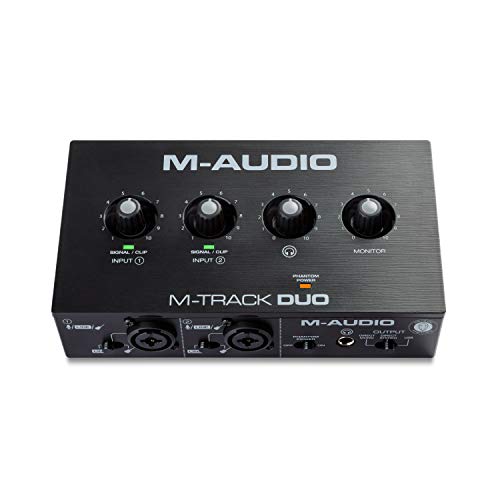
Ideal for musicians on the move, the M-AUDIO M-Track Duo USB Audio Interface offers a compact design that’s bus-powered, making it easy to record, stream, or podcast anywhere. With dual combo XLR/Line/Instrument inputs and phantom power, you can connect your instruments and microphones effortlessly. The interface delivers impressive 48kHz audio resolution and features a USB/Direct switch for zero-latency monitoring. It’s compatible with various devices and popular DAWs, ensuring seamless integration. Weighing just 0.3 kg, this interface is perfect for your on-the-go setup. Plus, you’ll enjoy a 1-year warranty and solid customer support, making it a reliable choice.
Best For: Musicians, podcasters, and streamers seeking a portable and high-quality audio interface for recording on the go.
Pros:
- Compact and lightweight design, making it ideal for portability.
- Dual combo inputs with phantom power allow for versatile connectivity.
- Zero-latency monitoring feature ensures real-time audio feedback during recording.
Cons:
- Limited audio resolution of 48kHz may not satisfy professional studio requirements.
- Lacks onboard effects or additional processing features.
- May require an adapter for iOS devices, which is sold separately.
Zoom AMS-44 USB Audio Interface for Musicians & Podcasters

The Zoom AMS-44 USB Audio Interface stands out for musicians and podcasters seeking versatility with its four inputs and outputs. You’ll appreciate the four XLR/TRS inputs, including one for guitar, plus two headphone outputs for monitoring. Choose between Music Mode, which sends individual tracks to your DAW, and Streaming Mode, which combines all inputs for easy routing. With hardware switches for loopback and direct monitoring, controlling your setup is simple. Best of all, it’s bus-powered, making it perfect for recording and streaming on the go, no matter if you’re using PC, Mac, iOS, or Android.
Best For: Musicians and podcasters looking for a versatile and portable audio interface for recording and streaming.
Pros:
- Versatile input options with 4 XLR/TRS inputs, including one for guitars, accommodating various recording needs.
- Two operational modes (Music Mode and Streaming Mode) allow for tailored setups depending on whether you’re recording or streaming.
- Bus-powered design makes it convenient for on-the-go use with compatibility across PC, Mac, iOS, and Android devices.
Cons:
- Limited number of outputs (only 2 main TRS outputs), which may not suffice for larger setups.
- No built-in effects or processing, meaning users will need additional software for sound enhancement.
- Potential learning curve for users unfamiliar with audio interfaces or DAW integration.
M-AUDIO M-Track Solo USB Audio Interface for Recording and Streaming
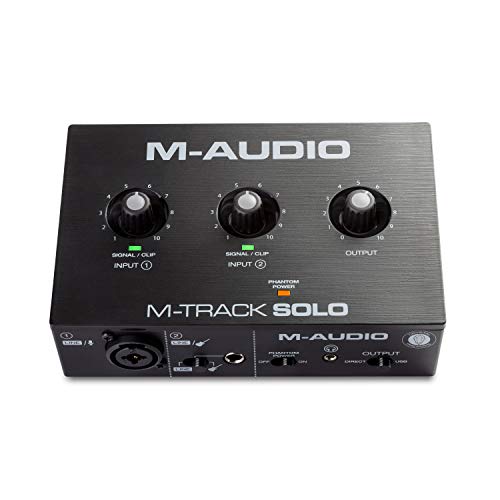
Musicians seeking a compact and versatile solution for recording and streaming will find the M-AUDIO M-Track Solo USB Audio Interface an excellent choice. This interface works seamlessly with both Mac and PC, delivering impressive 48kHz audio resolution. It features a combo XLR/Line input with phantom power and an additional Line/Instrument input, making it perfect for recording vocals and instruments. You’ll appreciate the zero-latency monitoring via the USB/Direct switch, while the transparent Crystal Preamp guarantees high-quality sound. Plus, it includes MPC Beats Software, giving you essential tools to elevate your music production game on the go.
Best For: Musicians and podcasters looking for a compact and high-quality audio interface for recording and streaming.
Pros:
- High audio resolution: Delivers 48kHz audio quality for clear recordings.
- Flexible input options: Features a combo XLR/Line input with phantom power and an additional Line/Instrument input for versatility.
- Zero-latency monitoring: USB/Direct switch allows for real-time monitoring without delays.
Cons:
- Limited input channels: Only offers one combo input and one additional line/instrument input, which may not be sufficient for larger setups.
- Basic software bundle: While it includes MPC Beats Software, more advanced software options may be preferred by professional users.
- No MIDI connectivity: Lacks MIDI input/output ports for those needing to connect MIDI devices.
Shure MVX2U XLR-to-USB Digital Audio Interface

For those seeking a versatile solution to connect microphones directly to a computer, the Shure MVX2U XLR-to-USB Digital Audio Interface stands out with its 60dB gain and 48V phantom power. It’s compatible with any microphone, making it perfect for both dynamic and condenser mics. The built-in 3.5mm headphone jack allows for zero-latency monitoring, ensuring you hear exactly what your audience hears. With dual mounting options, you can customize your setup to fit your recording needs. Plus, its compact design keeps your workspace tidy while providing high-quality audio performance on both Mac and Windows systems.
Best For: Podcasters, musicians, and content creators looking for a reliable and high-quality audio interface to connect their microphones directly to a computer.
Pros:
- High 60dB gain and 48V phantom power support dynamic and condenser mics.
- Zero-latency monitoring through the built-in headphone jack for real-time audio feedback.
- Compact design minimizes workspace clutter while maintaining excellent audio performance.
Cons:
- Limited to USB connectivity, which may not suit all setups.
- Requires USB-C compatibility, which may necessitate adapters for older devices.
- Some users may find the dual mounting options less intuitive for specific microphone setups.
MAONO USB Audio Interface for PC (PS22 Lite Black)

Looking for a compact and powerful audio interface? The MAONO USB Audio Interface PS22 Lite Black is perfect for you. With high-resolution recording at 24-bit/192kHz and a dynamic range of 106dB, it captures your sound with impressive clarity. Compatible with both PC and Mac, it supports condenser and dynamic microphones, offering up to 56 dB of preamp and 48V phantom power. You can also connect guitars through its dedicated instrument input. The included ProStudio Routing Software makes live streaming a breeze, while its plug-and-play functionality guarantees a smooth experience for beginners and pros alike.
Best For: The MAONO USB Audio Interface PS22 Lite Black is best for podcasters, musicians, and streamers seeking a compact and high-quality audio recording solution.
Pros:
- High-resolution recording at 24-bit/192kHz ensures clear and realistic sound capture.
- Compatible with various microphones and instruments, including guitars, with adjustable impedance.
- User-friendly design with plug-and-play functionality makes it accessible for both beginners and experienced users.
Cons:
- Limited to USB connectivity, which may not suit those looking for alternative connection options.
- The compact size may lead to concerns about durability during frequent transport.
- May require additional software setup for optimal streaming capabilities, which could be daunting for novice users.
Mackie Onyx Producer 2X2 USB Audio Interface

The Mackie Onyx Producer 2X2 USB Audio Interface stands out as an ideal choice for mobile recording enthusiasts who demand exceptional audio quality without the hassle of extra gear. With high-resolution 24-Bit/192kHz recording, it features two boutique-quality Onyx mic preamps that deliver class-leading fidelity. You’ll appreciate the versatility of XLR/TRS combo inputs for mic, line, and Hi-Z sources. Plus, zero-latency direct monitoring guarantees you hear every detail in real-time. Its bus-powered design means you won’t need an adapter, while the rugged construction assures durability. With MIDI I/O and the Musician Collection of plugins, it’s perfect for musicians on the go.
Best For: Mobile recording enthusiasts seeking high-quality audio without the need for additional equipment.
Pros:
- High-resolution recording at 24-Bit/192kHz ensures exceptional audio fidelity.
- Versatile input options with XLR/TRS combo inputs accommodate various audio sources, including microphones and instruments.
- Bus-powered design allows for easy portability, eliminating the need for an external power adapter.
Cons:
- Limited to 2 input channels, which may not suffice for larger recording setups.
- MIDI I/O functionality may not be necessary for all users, potentially adding complexity for those who don’t use MIDI.
- No onboard effects processing, requiring reliance on external plugins for sound enhancement.
Audio Interface 2X2 24-bit/192kHz for High-Fidelity Recording

Musicians seeking high-fidelity recording without the hassle of complicated setups will find the 2X2 24-bit/192kHz audio interface an ideal choice. This plug-and-play USB C interface works seamlessly with Mac, PC, and iOS, ensuring you can get started quickly. Its one-cable setup eliminates bulky power supplies, while the studio-grade fidelity and high-performance converters deliver crystal-clear recordings. With integrated 48V phantom power, you can easily use demanding microphones. The direct monitor feature allows for zero-latency tracking, and the elegant design with illuminated control knobs complements your workspace. Enjoy professional quality recording wherever your music takes you!
Best For: Musicians and content creators looking for a simple, high-quality recording solution without complicated setups.
Pros:
- Easy plug-and-play functionality with no drivers required for quick setup.
- Studio-grade 24-bit/192kHz audio fidelity for professional recording quality.
- Integrated 48V phantom power allows for use with a wide range of microphones.
Cons:
- Limited to two input channels, which may not suffice for larger setups.
- Requires USB C connection, which may necessitate adapters for some devices.
- The design may not appeal to all users, as aesthetics are subjective.
Factors to Consider When Choosing a Bus Powered Audio Interface
When you’re choosing a bus-powered audio interface, several key factors come into play. You’ll want to take into account audio quality standards, input and output options, and how portable the design is for your setup. Don’t forget to check software compatibility, price, and warranty to guarantee you get the best value for your needs.
Audio Quality Standards
Choosing a bus-powered audio interface involves understanding key audio quality standards that can greatly impact your recordings. Look for interfaces that feature a bit depth of 24-bit and a sample rate of 192kHz, which are common in professional settings. High-performance converters are vital for minimizing noise and distortion, helping you capture the nuances of sound effectively. Pay attention to the dynamic range, ideally around 120dB, as it allows for better differentiation between soft and loud sounds. If you plan to use condenser microphones, make sure your interface has phantom power (48V). Finally, integrated monitoring capabilities, like zero-latency monitoring, are essential for hearing your recordings in real-time, enhancing your performance accuracy.
Input and Output Options
Understanding the input and output options of a bus-powered audio interface is essential for maximizing your recording potential. First, consider how many inputs and outputs you need; more channels let you record multiple instruments or vocals simultaneously, enhancing your versatility. Look for combo inputs that accept both XLR and TRS connections, allowing easy connection of microphones and instruments. Make sure there are dedicated headphone and monitor outputs for real-time audio monitoring. Phantom power on XLR inputs is vital if you plan to use condenser microphones, as it improves recording quality. Finally, check for MIDI inputs and outputs to expand your setup and control additional gear. These features are key to creating a robust and flexible recording environment.
Portability and Design
Portability is a key factor for musicians and podcasters who need to record in various locations. Bus-powered audio interfaces are designed to be compact and lightweight, making them perfect for your on-the-go lifestyle. With streamlined layouts and intuitive controls, you can easily make adjustments during live performances or recording sessions. Many models feature a one-cable setup, eliminating the hassle of bulky external power supplies and enhancing portability. You’ll also appreciate the robust construction that guarantees durability against the rigors of travel while looking professional. Plus, with LED indicators for monitoring input levels, you’ll have visual feedback in low-light environments, making it easier to capture great sound wherever you are.
Software Compatibility
When selecting a bus-powered audio interface, ensuring its software compatibility is essential for a smooth recording experience. Make sure the interface works with popular digital audio workstations (DAWs) like Pro Tools, Ableton Live, and Cubase. This compatibility will streamline your recording and mixing process. Check for ASIO driver support to achieve low-latency performance, which is vital for real-time monitoring and streaming. Additionally, verify if the interface includes bundled software or plugins that enhance your recording experience. It’s also wise to opt for an interface that’s compatible with multiple operating systems like Windows, Mac, and iOS. Finally, consider features like loopback functionality, especially if you plan on live streaming or podcasting, ensuring the software supports this as well.
Price and Warranty
While choosing a bus-powered audio interface, you should keep an eye on both price and warranty to confirm you’re making a wise investment. Prices can range from budget-friendly options under $100 to high-end models exceeding $500, so evaluate what features matter most to you. A longer warranty, ideally up to three years, offers peace of mind about reliability. Also, look for interfaces that include software bundles, as these can add significant value without extra costs. Pay attention to customer feedback on warranty support, since positive experiences can impact your overall satisfaction. Finally, verify the interface’s features—like audio resolution and connectivity—meet your recording needs while staying within your budget.
