Compact streaming rigs need dependable video conversion without the size, cost, or complexity of a full production system. The right encoder can turn an HDMI or SDI source into a stable live stream while preserving space for cameras, lights, and audio gear.
This roundup compares 10 hardware options, from straightforward 1080p HDMI encoders to 4K NDI devices and all-in-one switchers. Pay close attention to input types, output protocols, resolution limits, networking, and whether you need standalone streaming or computer-assisted capture.
Best 10 Hardware Streaming Encoders for Compact Setups Picks for 2026
Best Protocol Flexibility

- 1080p60 H.265/H.264 hardware encoding
- Broad SRT, RTMP, RTSP, HLS, and WebRTC support
- Browser setup in a palm-sized enclosure
Best For: Network streaming, monitoring, IPTV, and digital signage
Best Premium 4K Workflow

- 4K60 HDMI input and zero-latency loop-out
- NDI|HX3/HX2 encode and decode support
- Touchscreen, tally, PTZ, and standalone streaming features
Best For: Compact 4K NDI production and portable professional workflows
Best Compact Production Hub
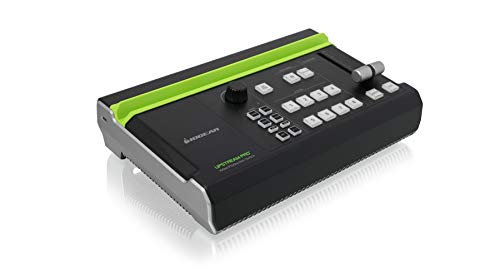
- Three HDMI inputs with 4K input support
- Direct H.264 recording to USB storage
- Integrated audio inputs, switching, and streaming
Best For: Small multi-source productions and PC-free live events
Best Value NDI Flexibility

- 4K HDMI passthrough with zero-lag monitoring
- NDI|HX3/HX2 conversion and IP decoding
- USB-C power, PoE, tripod mount, and web control
Best For: Compact gaming, streaming, and flexible NDI/IP video systems
Thunderbolt Capture Pick

- 1080p video capture
- Compact Thunderbolt design
- Windows and Linux support
Best For: Computer-based Thunderbolt capture and editing
Multi-Protocol Streaming Hub

- Dual simultaneous stream outputs
- Broad protocol support
- HDMI-to-IP encoding
Best For: Multi-destination HDMI live streaming
SDI-to-NDI Compact Pick

- SDI and NDI|HX workflows
- PC-free standalone streaming
- PoE, USB-C, and tripod support
Best For: Compact SDI and NDI|HX production systems
Pocket H.265 Encoder

- Pocket-sized, low-power HDMI encoder
- H.265/H.264 with SRT and RTMP support
- Dual-stream output and LinkCloud management
Best For: Portable and space-constrained streaming installations
All-in-One Production Hub

- Switches, encodes, records, and streams standalone
- HDMI, USB, IP, and mobile camera inputs
- 7-inch touchscreen and hot-swappable battery support
Best For: Mobile multi-source live production
Wireless Mobile Encoder

- Ultra-mini USB-powered HDMI encoder
- 1080p60 input with HEVC/H.264 encoding
- Hotspot connectivity and multi-platform output
Best For: Outdoor and mobile broadcasts
Best Protocol Flexibility – Compact 1080p60 HDMI Encoder
For buyers comparing hardware streaming encoders for compact setups, this palm-sized UNISHEEN model offers 1080p60 HDMI encoding without requiring a computer or dedicated streaming software. Its browser-based configuration and broad protocol support make it a practical fit for network video distribution, live events, monitoring, and digital signage.
Best For: Users who need a small, always-on HDMI encoder with flexible IP streaming options and browser-based management.
Pros:
- Supports 1080p60 hardware H.265 and H.264 encoding.
- Works with SRT, RTMP(S), RTSP, HLS, WebRTC, UDP, HTTP, and other protocols.
- Compact 90 × 54 × 29mm design with HDMI and external 3.5mm audio support.
- Built-in OSD can add text, logos, or timestamps to the stream.
Cons:
- Advanced configurations require basic networking knowledge.
- Uses a 12V DC power input and does not include a power plug in the listed specifications.
This encoder is particularly appealing when protocol compatibility and low-power, space-conscious installation matter more than local production controls. It is a focused streaming appliance rather than a full switcher.
Best Premium 4K Workflow – ZowieBox Pro 4K60 NDI Encoder
The Zowietek ZowieBox Pro is a strong option among hardware streaming encoders for compact setups when 4K video, NDI networking, and standalone operation are priorities. Its smartphone-sized aluminum body combines a touchscreen, tally light, HDMI loop-out, and support for professional IP workflows.
Best For: Portable production teams, presenters, churches, schools, and event operators building compact 4K NDI or direct-streaming systems.
Pros:
- Handles up to 4K60 HDMI input and output with zero-latency loop-out.
- Supports NDI|HX3/HX2 encoding and decoding with low 2–3 frame latency.
- Standalone RTMP, RTMPS, SRT, and RTSP streaming without a PC.
- Includes a 3.42-inch touchscreen, tally light, tripod thread, and optional PTZ/AI tracking features.
Cons:
- Does not support Full NDI or NDI|HB.
- Encoder and decoder modes cannot operate simultaneously.
- The listed feature set may be more than needed for simple single-source streaming.
Choose the ZowieBox Pro when compact size does not mean giving up 4K60 monitoring or NDI functionality. It is best suited to users who can take advantage of its professional networking and PTZ capabilities.
Best Compact Production Hub – IOGEAR 3-Input Video Switcher
Unlike single-source hardware streaming encoders for compact setups, the IOGEAR Upstream Pro combines switching, capture, recording, audio mixing, and streaming in one portable unit. Its three HDMI inputs make it useful for small productions that need to manage multiple cameras, computers, or mobile devices without a PC.
Best For: Small live productions that need multiple HDMI sources, direct recording, audio inputs, and PC-free streaming.
Pros:
- Provides three HDMI inputs, including two 1080p inputs and one 4K input.
- Supports preview, monitoring, recording, editing, and streaming from one device.
- Records directly to USB storage in H.264.
- Includes 1/4-inch microphone and RCA left/right audio inputs plus iPad app support.
Cons:
- Its maximum listed streaming output is 1080p at 30fps, despite a 4K input.
- At 1.9kg, it is less lightweight than the dedicated encoder boxes in this group.
- The supplied notes do not specify support for SRT, NDI, or RTSP workflows.
This is the better choice when source switching and audio handling are more important than the smallest possible footprint. It functions as a compact production station rather than a simple HDMI-to-IP encoder.
Best Value NDI Flexibility – ZowieBox 4K HDMI Encoder
For compact setups that need both HDMI passthrough and IP video conversion, the ZowieBox is a versatile choice among hardware streaming encoders for compact setups. It supports 4K workflows, NDI|HX conversion, standalone RTMP/SRT/RTSP streaming, and several installation options including USB-C power and PoE.
Best For: Gamers, streamers, and small production systems that need compact 4K HDMI passthrough plus NDI or IP streaming.
Pros:
- Supports up to 4K capture with zero-lag HDMI passthrough.
- Converts HDMI to NDI|HX3/HX2/HX and can decode IP video back to HDMI.
- Offers standalone SRT, RTMP(S), and RTSP streaming with web-based control.
- Compact aluminum body includes a screen, tally light, tripod mount, USB-C power, and PoE support.
Cons:
- Encoder and decoder modes cannot run simultaneously.
- It does not support full NDI signals.
- USB capture card functionality is not currently supported.
The ZowieBox stands out for fitting several IP-video roles into a small enclosure. It is a practical match for users who want gaming or HDMI passthrough today and NDI-based expansion later, provided its mode limitations fit the workflow.
Thunderbolt Capture Pick – Ultrastudio MINI Recorder
Blackmagic Design Ultrastudio MINI Recorder Video Editing Card, Hardware Encoder
Check Price On AmazonFor compact setups built around a Thunderbolt-equipped laptop or computer, the Blackmagic Design Ultrastudio MINI Recorder is a small hardware encoder and video capture option. It supports 1080p capture and works with Windows and Linux systems that meet its basic requirements.
Best For: Thunderbolt-based 1080p video capture and editing workflows.
Pros:
- Compact 5.2-by-5.2-by-1.6-inch design weighing 8.48 ounces.
- Supports 1080p video capture through a Thunderbolt connection.
- Compatible with Windows 7+ and Linux systems, with Blackmagic Media Express built in.
Cons:
- Requires a computer with a Thunderbolt port.
- Listed as a video editing card rather than a standalone PC-free streaming appliance.
This is a sensible fit when portability and computer-based capture matter more than broad network streaming compatibility. Check your computer’s Thunderbolt support and system specifications before buying.
Multi-Protocol Streaming Hub – Compact H.265/H.264 Encoder
For hardware streaming encoders for compact setups that need several network destinations, this URayCoder unit converts HDMI video to IP streams in a 7-by-5-by-1.5-inch aluminum enclosure. It supports H.265 and H.264 workflows, dual output streams per HDMI input, and a wide range of streaming protocols.
Best For: HDMI-based live production with multiple simultaneous streaming outputs.
Pros:
- Supports RTMPS, RTSP, SRT, HLS, UDP, RTP, MP4, FLV, WebRTC, and other protocols listed by the manufacturer.
- Can output two video streams simultaneously for each HDMI input, with different protocols for each stream.
- Allows adjustments such as resolution, frame rate, bitrate, cropping, rotation, logos, and text overlays.
- Includes free lifetime technical support and warranty service.
Cons:
- Requires an HDMI-output device and a 12-volt power supply.
- Its feature set may be more than needed for a simple single-destination stream.
This encoder stands out when a compact installation still needs flexible routing and customization. It is especially useful for sending different streams to multiple platforms or servers from one HDMI source.
SDI-to-NDI Compact Pick – ZowieBox Encoder/Decoder
The Zowietek ZowieBox is a compact aluminum encoder/decoder for production setups using SDI, NDI|HX, and network streaming. It can operate PC-free, supports PoE and USB-C power options, and includes a tripod mount for flexible placement in small streaming environments.
Best For: Compact SDI, NDI|HX, and standalone streaming workflows.
Pros:
- Encodes SDI to NDI or decodes NDI and supported network streams to SDI.
- Supports NDI|HX3, NDI|HX2, RTMP(S), RTSP, and SRT workflows.
- Offers PoE, USB Type-C, and DC power options in a six-ounce aluminum enclosure.
- Can convert UVC cameras to SDI and supports point-to-point SDI transmission with two units.
Cons:
- Cannot encode and decode simultaneously; users must switch between modes.
- Supports NDI|HX formats but not full NDI|HB.
- USB capture-card functionality is not supported.
Choose this model when your compact setup relies on SDI and NDI|HX rather than a conventional HDMI-only workflow. Its flexible power and mounting options are useful for mobile or space-constrained production, but the mode limitation should be planned for.
Pocket H.265 Encoder – DDMALL AVC-2K
For buyers comparing hardware streaming encoders for compact setups, the DDMALL AVC-2K stands out for its pocket-sized design, low 2.4W power draw, and support for up to 1080p60 input. It can encode at 1080p30 using H.265 or H.264 and connects with a range of HDMI sources, including cameras, PCs, drones, and NVRs.
Best For: Portable broadcasts, surveillance feeds, and installations where space and power are limited.
Pros:
- Very small 2.95 x 1.26 x 0.87-inch enclosure weighing about 1.13 ounces.
- Supports H.265/H.264 encoding and protocols including SRT, RTMP, RTMPS, HLS, RTSP, and UDP.
- Offers dual-stream output, OSD overlays, web preview, and optional LinkCloud remote management.
Cons:
- Encoding output is limited to 1080p30, despite accepting up to 1080p60 input.
- Requires a separate HDMI source and streaming workflow rather than providing production switching.
The AVC-2K is a focused encoder rather than an all-in-one production system. Its combination of minimal size, low power use, broad protocol support, and remote-management options makes it a practical fit for distributed or mobile deployments.
All-in-One Production Hub – Magewell Director One
The Magewell Director One is a strong choice for hardware streaming encoders for compact setups when you need switching, recording, monitoring, and streaming in one standalone unit. It combines HDMI, USB, and IP inputs with a 7-inch AMOLED touchscreen, hardware encoding up to 1080p60, and flexible wired or wireless connectivity.
Best For: Mobile productions and creators who want multi-source switching without a separate computer or HDMI switcher.
Pros:
- Combines switching, encoding, recording, monitoring, and streaming in a single system.
- Accepts up to two HDMI sources, two USB-A sources, and three simultaneous IP sources.
- Includes a 7-inch AMOLED touchscreen, HDMI program output, scene tools, and recording to SD cards or internal storage.
- Supports DC power and dual hot-swappable batteries for field use.
Cons:
- Larger and more feature-heavy than a simple single-source encoder.
- The integrated 4G modem requires separate 4G service.
Director One is the most capable option here for complete live production. Its added size and complexity are justified when a compact setup still needs multiple sources, graphics, recording, touchscreen control, and mobile connectivity.
Wireless Mobile Encoder – DDMALL HEV-2KW
For hardware streaming encoders for compact setups that need wireless flexibility, the DDMALL HEV-2KW pairs an ultra-mini HDMI design with USB power, 1080p60 input, and H.265/H.264 encoding. It can connect through 4G or 5G hotspots and supports SRT, RTMP, RTMPS, RTSP, UDP, and HLS workflows.
Best For: Outdoor events, churches, weddings, drone feeds, and other mobile broadcasts using hotspot connectivity.
Pros:
- Compact 2.95 x 1.26 x 0.59-inch form factor with USB power and 2.6W consumption.
- Supports 1080p60 input, HEVC/H.265 and H.264 encoding, and dual-stream output to up to four platforms.
- Physical one-button live control, web preview, OSD settings, and LinkCloud remote management.
- NTP synchronization helps align multiple encoders in multi-camera productions.
Cons:
- Designed around 1080p workflows rather than higher-resolution streaming.
- Wireless operation depends on a suitable 4G/5G hotspot or other network connection.
The HEV-2KW is a particularly portable choice for broadcasts away from a fixed network. Its hotspot compatibility, one-button control, multi-platform output, and NTP support make it more field-oriented than a basic wired encoder.
How We Picked These Hardware Streaming Encoders for Compact Setups
We focused on devices that reduce the need for a computer or large production rack while supporting practical live-video workflows. The selection includes HDMI and SDI encoders, NDI-capable units, wireless and wired models, capture hardware, and integrated switcher-encoder systems.
We compared each product’s maximum resolution and frame rate, codec support, streaming protocols, input and output options, portability, monitoring features, and suitability for platforms such as YouTube Live and Facebook Live. Because compact setups vary widely, the list includes both simple single-source encoders and more capable production hubs.
Quick Comparison
- Best for basic HDMI streaming: A compact H.264/H.265 HDMI encoder with RTMP, RTSP, SRT, or HLS support.
- Best for 4K and NDI workflows: ZowieBox models with 4K HDMI or 3G-SDI connectivity.
- Best for multi-source production: The IOGEAR switcher or Magewell Director One.
- Best for computer-assisted capture: Blackmagic Design UltraStudio Mini Recorder.
- Best for wireless flexibility: The DDMALL wireless HDMI encoder.
Key Buying Factors for Hardware Streaming Encoders for Compact Setups
Inputs and Signal Compatibility
Start with the output on your camera, mixer, or switcher. HDMI is common for mirrorless cameras and consumer video gear, while SDI is better suited to longer cable runs and professional cameras. NDI models are useful when video must move across a local network rather than through dedicated video cabling.
Resolution, Frame Rate, and Codecs
1080p60 is often the most practical target for compact streaming because it balances image quality, bandwidth, and device cost. Choose 4K support if you need local recording, 4K distribution, or future-proofing. H.265 can reduce bandwidth compared with H.264, but verify that your streaming platform and receiving hardware support it.
Protocols and Network Requirements
RTMP is widely supported, while SRT can provide better resilience over unreliable connections. RTSP, HLS, UDP, and WebRTC may matter for surveillance, IPTV, internal distribution, or browser-based playback. Wired Ethernet is generally more stable than Wi-Fi for primary streams.
Standalone Operation and Control
Look for onboard screens, web interfaces, presets, recording, audio handling, and automatic reconnect features if you want a PC-free workflow. A capture device may be smaller and less expensive, but it still depends on a computer running streaming software.
Who Should Buy Which Hardware Streaming Encoders for Compact Setups?
Choose a basic HDMI encoder if you stream one camera and want the smallest practical setup. Choose a 4K NDI encoder if your workflow already uses network video or requires flexible routing. SDI models fit professional cameras and longer cable paths. A switcher-encoder is the better choice when you need multiple HDMI sources, overlays, recording, or transitions in one device.
Finally, select a capture card when software control is more important than standalone operation. Before buying, confirm connector types, supported frame rates, required network speed, power requirements, and compatibility with your streaming platform.
