The right field monitor can make focusing, framing, exposure, and color decisions much easier when your camera’s built-in screen is not enough. Brightness, monitoring tools, recording support, and portability all matter on set.
We compared 10 field monitors for filmmaking across screen size, daylight visibility, resolution, touch controls, HDR and LUT support, connectivity, and overall workflow value.
Best 10 Field Monitors for Filmmaking Picks for 2026
Bright Touchscreen Pick
NEEWER F700 7-inch Field Monitor

- 2000-nit touchscreen for bright shooting environments
- 4K HDMI loop-through and professional scopes
- NP-F, USB-C, and DC power options
Best For: Outdoor filmmakers wanting a bright, feature-rich touchscreen
Professional Recording Monitor
Blackmagic Video Assist 7-inch 12G

- 2500-cd/m² HDR display
- SDI and HDMI connectivity
- 1920x1200 7-inch monitoring surface
Best For: Professional SDI and HDMI production workflows
OLED Connectivity Upgrade
NEEWER F700U 7-inch Field Monitor

- OLED display with 100000:1 contrast
- 4K HDMI loop-through and 3G-SDI I/O
- Two NP-F750 batteries included
Best For: Shoots needing OLED contrast and HDMI/SDI flexibility
Camera-Control Specialist
Portkeys LH5P III 5.7-inch Monitor

- 2200-nit 10-bit daylight-viewable display
- Touch focus tracking and camera control
- 4K60p HDMI input and output
Best For: Solo operators using compatible mirrorless or cinema cameras
Best Brightness-to-Weight Pick
FEELWORLD FW568 PRO 6-Inch Monitor

- 1200-nit Full HD IPS display
- Waveform, vectorscope, histogram, and focus assist
- Lightweight design with 4K HDMI I/O
Best For: Outdoor shoots and lightweight camera rigs
Best Budget HD Viewing Kit
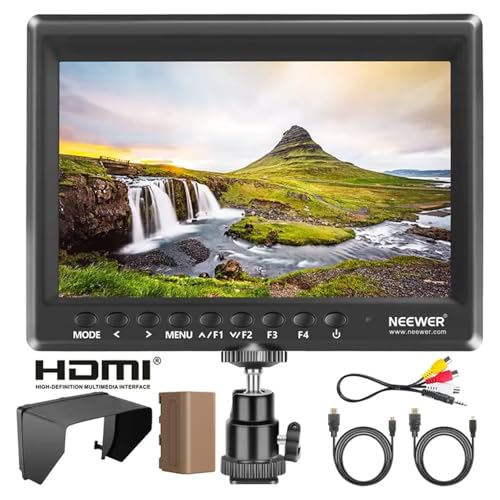
- 7-inch IPS screen with 1280x800 resolution
- Includes battery, sunshade, ball head, and cables
- Peaking, histogram, safe frames, and image tools
Best For: Beginners and general-purpose HD monitoring
Best Pro Daylight Monitor

- 2800-nit Full HD touchscreen for bright locations
- 4K 60Hz HDMI 2.0 input/output
- Waveform, false color, vectorscope, and custom 3D LUTs
Best For: Professional outdoor and commercial productions
Bright Outdoor Pick
FEELWORLD F5 Prox 5.5-Inch Field Monitor

- 1600-nit display for direct-sunlight visibility
- Focus, exposure, waveform, and false-color tools
- LUT preview and flexible mounting options
Best For: Outdoor shoots and creators needing maximum screen brightness
Most Complete Kit
VILTROX DC-550 Touch Field Monitor

- 1200-nit touchscreen with 4K HDMI in/out
- Includes scopes, focus assist, false color, and 3D LUT support
- Battery, sunshade, cables, and case included
Best For: Filmmakers wanting a versatile monitor package out of the box
Best Built-In Battery

- Built-in 3300mAh battery for cable-free operation
- 1200-nit 6-inch touchscreen for outdoor use
- Waveform, vectorscope, histogram, and LUT support
Best For: Portable shoots where integrated power and low weight matter
Bright Touchscreen Pick – NEEWER F700 7-inch Field Monitor
For filmmakers who need a highly visible setup in changing light, the NEEWER F700 combines a 7-inch 1920×1080 touchscreen with 2000-nit brightness and automatic or manual backlight control. It is a flexible choice among field monitors for filmmaking, with HDMI loop-through, professional exposure tools, LUT support, and several power options.
Best For: Outdoor filmmakers and camera operators who want a bright touchscreen with extensive monitoring aids.
Pros:
- 2000-nit IPS display with 160-degree viewing angle and 180-degree adjustable mounting.
- 4K HDMI input and loop output, plus headphone audio monitoring.
- Includes tools such as waveform, vectorscope, false color, zebras, histogram, and focus peaking.
- Supports NP-F batteries, USB-C charging, and up to 60 custom 3D LUTs.
Cons:
- SD card and DC power cable are not included.
- Battery runtime is listed at about 2.4 hours per NP-F750 battery.
- The unit weighs 15.7 ounces without batteries and 30.2 ounces with two installed.
The F700 is a practical all-rounder when brightness and hands-on controls matter most. Its broad signal support and monitoring features make it well suited to demanding on-set workflows, while the cooling fans support extended use.
Professional Recording Monitor – Blackmagic Video Assist 7-inch 12G
Blackmagic Design Video Assist 7" 12G-SDI/HDMI HDR Recording Monitor (HYPERD/AVIDA12/7HDR)
Check Price On AmazonThe Blackmagic Design Video Assist is aimed at productions that need more than basic framing. Its 7-inch HDR display reaches 2500 cd/m², supports 1920×1200 resolution, and accepts SDI or HDMI connections, making it a strong professional option among field monitors for filmmaking.
Best For: Professional crews working with SDI- or HDMI-equipped cameras and HDR monitoring needs.
Pros:
- Bright 2500-cd/m² display with HDR and 3D LUT support.
- Supports both SDI and HDMI camera connections.
- 7-inch screen provides a larger monitoring surface for production work.
Cons:
- The supplied notes do not specify detailed recording formats or storage capacity.
- Its listed connectivity is more specialized than a simple HDMI-only monitor setup.
- The product information does not provide a detailed battery-runtime figure.
Video Assist makes the most sense for filmmakers already using professional SDI workflows or who value HDR-oriented monitoring. Confirm the specific recording and camera compatibility requirements for your rig before buying.
OLED Connectivity Upgrade – NEEWER F700U 7-inch Field Monitor
The NEEWER F700U pairs a 7-inch 1920×1080 OLED touchscreen with HDMI loop-through and 3G-SDI input and output. Its 1200-nit brightness, 100000:1 contrast ratio, built-in scopes, and included NP-F750 batteries make it a versatile choice for filmmakers comparing field monitors for filmmaking.
Best For: Videographers who need OLED contrast and both HDMI and SDI connections in one monitor.
Pros:
- OLED panel offers a 100000:1 contrast ratio with 1200-nit brightness.
- Provides 4K HDMI input and loop output plus 3G-SDI input and output.
- Includes waveform, vectorscope, false color, zebra, histogram, HDR, and audio-level tools.
- Comes with two 4400mAh NP-F750 batteries and supports USB-C charging.
Cons:
- SDI cables and the DC 12V adapter are not included.
- SDI support is specified for HD formats up to 1920×1080.
- The 1200-nit screen is less bright on paper than the 2000-nit NEEWER F700.
The F700U is a compelling fit when contrast and connection flexibility are priorities. Its OLED display is useful for judging image detail, while HDMI and SDI support lets it adapt to a wider range of camera setups.
Camera-Control Specialist – Portkeys LH5P III 5.7-inch Monitor
The Portkeys LH5P III stands out for filmmakers who want a compact monitor that can also interact with compatible cameras. Its 2200-nit touchscreen, 10-bit processing, 4K60p HDMI loop-through, touch focus tracking, and log exposure tools give it a specialized role among field monitors for filmmaking.
Best For: Solo operators and mirrorless or cinema-camera users who need bright monitoring plus wired or wireless camera control.
Pros:
- 2200-nit display is designed for clear outdoor viewing without a sunhood.
- 10-bit processing, factory calibration, and up to 104% P3 coverage support color-critical monitoring.
- Touch focus tracking and wired or wireless control support many compatible cameras.
- 4K60p HDMI input and output, plus log stops exposure assistance and professional scopes.
Cons:
- Camera-control features depend on compatible camera models and connections.
- The supplied details list a 5.5-inch screen, while the product title identifies it as 5.7 inches.
- Its specialized controls may require a firmware upgrade for broader camera support.
The LH5P III is particularly attractive for solo filmmaking, where touch focus and camera control can reduce the need for a second operator. Its bright, calibrated display and log-focused exposure tools also suit demanding outdoor and cinematic workflows.
Best Brightness-to-Weight Pick – FEELWORLD FW568 PRO 6-Inch Monitor
For filmmakers who need field monitors for filmmaking without adding much weight to a camera rig, the FEELWORLD FW568 PRO combines a Full HD display, 1200-nit brightness, and useful exposure and focus tools in a compact 6-inch design. Its 4K HDMI input/output and LUT preview support make it a practical upgrade over a camera’s built-in screen.
Best For: Outdoor filmmakers, gimbal users, wedding shooters, vloggers, and creators who prioritize a lightweight monitor with professional exposure and focus aids.
Pros:
- Bright 1200-nit IPS screen is designed for clearer outdoor viewing.
- Waveform, vectorscope, RGB histogram, focus assist, and LUT preview support more accurate monitoring.
- 1920×1080 resolution with 4K HDMI input/output.
- Supports NP-F battery or USB-C power and includes DC 8.4V camera output.
Cons:
- The 6-inch display is smaller than the 7-inch alternatives.
- Its feature-rich monitoring setup may be more than casual users need.
The FW568 PRO is a balanced choice when sunlight visibility, monitoring tools, and low rig weight matter more than having the largest possible screen.
Best Budget HD Viewing Kit – NEEWER F100 7-Inch Monitor
The NEEWER F100 is a straightforward option for field monitors for filmmaking, offering a large 7-inch IPS screen, broad HD format support, and a bundled battery, sunshade, and mounting head. Its 1280×800 resolution and 450-nit brightness suit general video monitoring, especially when a larger preview is more useful than Full HD detail.
Best For: Beginner filmmakers, content creators, and camera operators seeking a larger HD monitor with accessories included for immediate setup.
Pros:
- Large 7-inch IPS display with a wide viewing angle and matte finish.
- Includes peaking, histogram, safe frames, image freeze, pixel-to-pixel, and other monitoring tools.
- 4400mAh F750 battery provides a stated 3.5 hours of runtime.
- Bundle includes a sunshade, mini ball head, battery, and multiple video cables.
Cons:
- 1280×800 resolution is lower than the Full HD displays in the other options.
- 450-nit brightness may be less suitable for direct sunlight.
- The monitor is relatively substantial for smaller camera rigs.
The F100 stands out as an accessible, accessory-rich monitoring package, but filmmakers working outdoors or checking fine focus may prefer a brighter Full HD model.
Best Pro Daylight Monitor – VILTROX DC-A1 7-Inch Monitor
For demanding field monitors for filmmaking, the VILTROX DC-A1 pairs a 7-inch Full HD touchscreen with exceptionally high claimed brightness, 4K 60Hz HDMI 2.0 input/output, and a broad set of professional monitoring tools. Custom 3D LUT support, waveform, vectorscope, false color, and physical shortcut buttons make it suited to fast-paced work on location.
Best For: Professional filmmakers, documentary crews, commercial productions, and outdoor shoots requiring strong daylight visibility and advanced signal monitoring.
Pros:
- 2800-nit 7-inch display is designed for direct-sunlight viewing.
- Supports 4K 60Hz HDMI pass-through and real-time audio via a headphone jack.
- Includes waveform, vectorscope, histogram, false color, focus peaking, and custom 3D LUT support.
- Offers touchscreen control, multiple power options, a sun hood, and a hard-shell case.
Cons:
- The advanced feature set may be excessive for simple framing and playback.
- Its 7-inch form factor can add more bulk to compact rigs.
- The supplied notes list a glossy screen finish, which may still require careful positioning outdoors.
The DC-A1 is the most production-oriented option here, especially for crews that need daylight performance, high-resolution signal handling, and quick access to professional exposure and color tools.
Bright Outdoor Pick – FEELWORLD F5 Prox 5.5-Inch Field Monitor
For filmmakers who need dependable visibility outdoors, the FEELWORLD F5 Prox is one of the more practical field monitors for filmmaking. Its 1600-nit screen is designed for direct-sunlight viewing, while focus and exposure tools help you judge shots more accurately than a camera’s built-in display.
Best For: Outdoor filmmakers, wedding shooters, vloggers, and creators using DSLR, mirrorless, or cinema cameras.
Pros:
- Very bright 1600-nit display for outdoor monitoring.
- Includes focus peaking, waveform, histogram, and false-color tools.
- Supports LUT preview for Log shooting.
- Mounts to rigs, cages, gimbals, tripods, and handheld setups.
Cons:
- Requires a separate camera battery or power setup; battery life is not specified in the supplied details.
- At 2.82 pounds in the package details, it may be less appealing for especially weight-sensitive setups.
The F5 Prox stands out when sunlight readability is the priority. It offers a strong set of production tools and broad mounting compatibility, making it a capable choice for mobile field work and professional on-set monitoring.
Most Complete Kit – VILTROX DC-550 Touch Field Monitor
The VILTROX DC-550 is a well-equipped option among field monitors for filmmaking, combining a 1200-nit touchscreen with 4K HDMI input and output. Its monitoring tools, included accessories, and multiple power options make it suited to both portable production and more organized camera-rig setups.
Best For: Filmmakers who want a touchscreen monitor with 3D LUT support, HDMI loop-through, and an included battery and sunshade.
Pros:
- 1200-nit screen with anti-glare IPS display and wide viewing angles.
- Offers waveform, vectorscope, histogram, false color, and focus-assist functions.
- Supports 4K HDMI signals and HDMI output for viewing by a director or crew member.
- Includes an NP-F550 battery, sunshade, cables, case, and cold-shoe adapter.
Cons:
- Native display resolution is 1920 × 1080 despite support for higher-resolution HDMI signals.
- Its 5.5-inch size may feel limiting when multiple crew members need to view the image.
The DC-550 is especially attractive for buyers who want a ready-to-use package rather than a bare monitor. Multiple power choices and HDMI loop-through add flexibility, while the professional scopes and LUT support cover common production needs.
Best Built-In Battery – FEELWORLD P6XL 6-Inch Monitor
The FEELWORLD P6XL offers a useful balance of screen size and portability for field monitors for filmmaking. Its 6-inch 1200-nit display improves visibility outdoors, while the built-in 3300mAh battery reduces the need to attach an external battery during short field sessions.
Best For: Mobile filmmakers, travel vloggers, and DSLR or mirrorless users who prefer an integrated battery and a slightly larger monitoring screen.
Pros:
- Built-in 3300mAh battery provides up to about 3 hours at 60% brightness.
- 6-inch Full HD IPS touchscreen with 1200-nit brightness.
- Includes waveform, vectorscope, histogram, focus assist, and 3D LUT support.
- Lightweight design and 1/4-20 mounting threads suit rigs and stabilizers.
Cons:
- Battery runtime drops to about 2.2 hours at full brightness.
- It may still require recharging or an alternate power plan for extended production days.
The P6XL is a practical choice when you want a larger-than-camera display without immediately adding an external battery system. Its built-in power source and lightweight construction favor fast-moving shoots, though longer sessions will require charging breaks or additional planning.
How We Picked the Best Field Monitors for Filmmaking
We focused on features that affect real production work rather than treating resolution alone as the deciding factor. The selected monitors cover several common needs, including bright outdoor viewing, compact camera rigs, touchscreen control, focus assistance, 3D LUT support, and external recording.
We also considered the practical differences between 5.5-inch, 6-inch, and 7-inch displays; HDMI-only monitors and models with SDI; stated brightness; panel technology; battery arrangements; and support for modern 4K signals. Since cameras and shooting styles vary, the list includes both affordable video-assist screens and more advanced production monitors.
Quick Comparison
| What to Compare | Best Fit |
|---|---|
| Maximum daylight visibility | High-brightness models rated from 2,000 to 2,800 nits |
| Compact handheld or gimbal rigs | 5.5-inch and 5.7-inch monitors |
| Larger viewing area | 6-inch and 7-inch displays |
| Touchscreen operation | Models with touch focus, menus, or tracking controls |
| Recording and professional connectivity | Video Assist-style monitors with recording and SDI support |
| Budget video assistance | Basic 1080p HDMI monitors with focus and exposure tools |
Key Buying Factors for Field Monitors for Filmmaking
Brightness and Outdoor Visibility
Brightness is one of the most important specifications for exterior shoots. A monitor rated around 1,200 nits can be substantially easier to see than a standard camera display, while 2,000 nits or more is particularly useful in direct sunlight. A sun hood can still help by reducing reflections and conserving battery power.
Size, Resolution, and Panel Type
A 7-inch screen gives a director, operator, or focus puller more room to inspect the image, but it adds weight to a small rig. Smaller monitors are easier to mount on gimbals and cages. Full HD is generally sufficient for monitoring, while OLED panels may offer stronger contrast and deeper blacks than conventional IPS screens.
Monitoring Tools and Color Workflow
Look for waveform, vectorscope, false color, zebras, peaking, zoom, and anamorphic or aspect-ratio options. 3D LUT support is useful when viewing a more finished version of a log image, but it should not replace proper exposure tools. Check whether the monitor supports the camera’s signal format, frame rate, and bit depth.
Inputs, Recording, and Power
Confirm whether you need HDMI, SDI, or both, especially for cinema cameras and longer cable runs. Recording-capable monitors can reduce the need for a separate recorder, but they are typically larger and more expensive. Also verify battery type, included plates, DC input options, runtime, and whether the monitor can operate while charging.
Who Should Buy Which Field Monitors for Filmmaking?
- Choose a high-brightness 7-inch monitor for outdoor filmmaking, documentary work, and crews that need a clear image in harsh daylight.
- Choose a compact 5.5-inch or 5.7-inch model for gimbals, handheld cameras, travel kits, and lightweight mirrorless rigs.
- Choose an OLED option if contrast and black-level visibility are priorities for controlled lighting environments.
- Choose a monitor with touch focus or tracking tools when fast solo operation and on-screen camera control matter.
- Choose a recording monitor with SDI for professional workflows that need dependable connectivity and onboard capture.
- Choose a basic 1080p video-assist monitor if your main goals are larger framing, focus peaking, exposure checks, and a more usable screen at a lower cost.
Before buying, match the monitor’s inputs, mounting method, power system, and supported signal formats to your camera. The best field monitor is the one that improves visibility without making your rig unnecessarily heavy or complicated.
